
 For Longline Fishermen
This device came about as a result of an enquiry from a Patagonian toothfish company. They experience predation,
mainly from Orcas, of up to 80% of their hooked catch, particularly when using the standard Spanish longline
configuration. Depredation is reduced when using other longline systems such as the Chilean “Cachalotera” system
but it appears that the Orcas develop new skills to work around this i.e. one Orca pushes the cachalotera up off the
fish while another takes it off the hook.
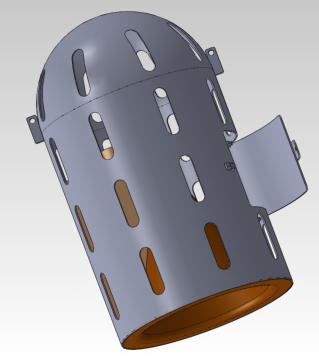
The “My-Fishi Shuttle” anti-depredation device is based on
the principle of stripping the fish off the longline as it is
hauled up and encapsulating them in a mechanical structure
which is impenetrable to the Orcas and other predators.
In its most basic form, there is internally a simple
mechanism that strips the fish off the hooks, a trap door
through which the fish then pass into the containment area
and a hatch through which the fish are removed when the
shuttle is hauled on board.
The cut-outs in the outer skin do provide some size
selectivity and hence their shape and size is tailored to the
target species.
It is a purely mechanical device - no motors, electronics or
sensors.
In operation, the longline is set in the normal way. At haul time, after the anchor has been brought on board the
shuttle is put onto the mainline. The mainline is then fed to the line hauler and the hauling process started. The
shuttle, which may be attached to a separate haul line, is then put over the side. As it travels downwards it will first
pass through the depredation zone when the predators can attack the hooked fish.
It would then enter its operational zone i.e. from the bottom of the depredation zone to just above the sea bed. As
the shuttle moves downwards, the mainline (and other branchlines, snap lines, additional lines and snoods) move
upwards through the center of the shuttle. The downward movement of the shuttle though the water column creates
a strong water flow through the shuttle. If there is a fish on a hook entering the shuttle, it will be stripped off by the
hook stripper. The water flow will force the unhooked fish through the fish hatch in the shuttle and into the
containment area. This process will continue until the shuttle reaches the seabed or some set depth.
At this point, the direction of the shuttle is reversed and it is hauled upwards towards the vessel. The water flow
direction also reverses, holding the trap door closed. The shuttle should be hauled up faster than the longline itself so
that it reaches the top of its operational zone before any fish do. Once there, the direction of the shuttle is reversed
again, repeating the cycle. After a predetermined number of cycles or when all the hooks have been through the
shuttle, it can be hauled back onto the vessel and the fish removed through a locked fish removal hatch.
The My-Fishi Shuttle offers the following benefits:
o
Can be attached and detached to the longline at any time during the fishing operation
o
Only one device per vessel required
o
Able to handle most longline configurations
o
Some selectivity - (determined by cut-out shape and size)
o
No foul-hooking of fish once they are in the containment pod area
o
Can be used from either end of the longline
o
Opening and closing of hatch controlled by water flow - no fancy mechatronics
o
Predators should come off second best if they try to "engage" the device
o
No potentially ear-damaging acoustics
o
Should not significantly slow down the hauling operation
o
Compatible with autoline systems
For more detailed information or to discuss your specific requirements please contact Active Fishing Systems.
For Longline Fishermen
This device came about as a result of an enquiry from a Patagonian toothfish company. They experience predation,
mainly from Orcas, of up to 80% of their hooked catch, particularly when using the standard Spanish longline
configuration. Depredation is reduced when using other longline systems such as the Chilean “Cachalotera” system
but it appears that the Orcas develop new skills to work around this i.e. one Orca pushes the cachalotera up off the
fish while another takes it off the hook.
The “My-Fishi Shuttle” anti-depredation device is based on
the principle of stripping the fish off the longline as it is
hauled up and encapsulating them in a mechanical structure
which is impenetrable to the Orcas and other predators.
In its most basic form, there is internally a simple
mechanism that strips the fish off the hooks, a trap door
through which the fish then pass into the containment area
and a hatch through which the fish are removed when the
shuttle is hauled on board.
The cut-outs in the outer skin do provide some size
selectivity and hence their shape and size is tailored to the
target species.
It is a purely mechanical device - no motors, electronics or
sensors.
In operation, the longline is set in the normal way. At haul time, after the anchor has been brought on board the
shuttle is put onto the mainline. The mainline is then fed to the line hauler and the hauling process started. The
shuttle, which may be attached to a separate haul line, is then put over the side. As it travels downwards it will first
pass through the depredation zone when the predators can attack the hooked fish.
It would then enter its operational zone i.e. from the bottom of the depredation zone to just above the sea bed. As
the shuttle moves downwards, the mainline (and other branchlines, snap lines, additional lines and snoods) move
upwards through the center of the shuttle. The downward movement of the shuttle though the water column creates
a strong water flow through the shuttle. If there is a fish on a hook entering the shuttle, it will be stripped off by the
hook stripper. The water flow will force the unhooked fish through the fish hatch in the shuttle and into the
containment area. This process will continue until the shuttle reaches the seabed or some set depth.
At this point, the direction of the shuttle is reversed and it is hauled upwards towards the vessel. The water flow
direction also reverses, holding the trap door closed. The shuttle should be hauled up faster than the longline itself so
that it reaches the top of its operational zone before any fish do. Once there, the direction of the shuttle is reversed
again, repeating the cycle. After a predetermined number of cycles or when all the hooks have been through the
shuttle, it can be hauled back onto the vessel and the fish removed through a locked fish removal hatch.
The My-Fishi Shuttle offers the following benefits:
o
Can be attached and detached to the longline at any time during the fishing operation
o
Only one device per vessel required
o
Able to handle most longline configurations
o
Some selectivity - (determined by cut-out shape and size)
o
No foul-hooking of fish once they are in the containment pod area
o
Can be used from either end of the longline
o
Opening and closing of hatch controlled by water flow - no fancy mechatronics
o
Predators should come off second best if they try to "engage" the device
o
No potentially ear-damaging acoustics
o
Should not significantly slow down the hauling operation
o
Compatible with autoline systems
For more detailed information or to discuss your specific requirements please contact Active Fishing Systems.
Copyright Active Fishing Systems 2016
Active Fishing Systems
The Emerging Light in Fishing Technology
Anti-
Depredation
Device