
 Development Status
The Active Trawl System concept was seeded in the 1960's but remained an idea for 30 years :- only in the last two
decades or so have technologies become available and affordable to ensure that the concept could be turned into
reality.
The first "concept demonstrator" model was built using scrap box
components and tested in a swimming pool to prove that practice
conformed to theory. Although it was not aesthetically pleasing, it
clearly illustrated that the concept of thrust vectoring using rotating
cylinders, is valid.
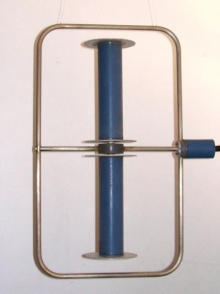
A scale model of a Variable Thrust Vector Device, shown on the left,
was manufactured and tested under controlled conditions in the towing
tank at the University of Stellenbosch.
Besides confirming once again the validity of the thrust vectoring
concept, valuable information with respect to the hydrodynamic
characteristics of the variable thrust vector devices was obtained.
Feedback from prospective customers and partners indicated that the "full
on" rotor device might be too radical a change for the fishermen to accept.
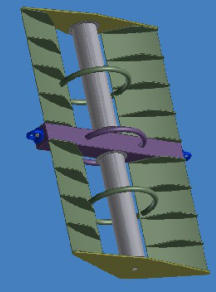
As such, an intermediate "rotors in a door" version was designed.
This incorporates smaller rotors in a substantial frame which also provides
some additional "conventional" lift force.
While this does, in some cases, influence the effectiveness of some of the
attractive features of the original concept, an acceptable degree of control
over the position of the trawl is still easily attainable.
Some of the merits of this design are (a) it is more acceptable to the
fishermen, (b) it provides an extra measure of safety against collapsing of
the trawl, (c) additional strength and protection is provided to the rotors
and (d) the power requirement of the system is reduced.
Other feedback from prospective customers and partners indicated that the fishermen were not keen on having a
third cable for power and communications as in the initial concept. Some felt that it would add to the handling
problems, increase the number of seabird deaths as well as being a potential safety hazard.
The R&D focus then shifted to finding a cable-less solution, Various battery-pack and power-saving options were
investigated but all seemed to add to the weight and size of the VTVD or placed an operational limit on the trawl time
and functionality. The considerable effort and resources which were put in, have resulted in a design which is cable-
less and with all the features and functionality of the original cable concept but without the time constraints of a
battery system.
The "design intent" of the ATS system is to keep the VTVD's off the seabed during normal trawling operations and
hence they are engineered to be unstable when they touch the seabed. This forcing to fly them off the bottom
prevents damage to the VTVD’s themselves and also makes the ATS more environment-friendly and less destructive
to the seabed than conventional trawl systems.
A further spin-off is that, by not having the extra cable and associated equipment the overall cost of the system can
be significantly reduced. Additionally the drag can be reduced as well.
The current status is that a full size VTVD has been designed, taking into account the off-the-shelf availability of
materials and standard components, manufacturing methods, corrosion resistance, ease of assembly as well as the
ability to perform routine maintenance and to replace wear parts easily on board the trawler. A comprehensive
manufacturing data pack is being completed which will enable an accurate costing to be obtained.
(Please note that the new mechanical design of the cableless VTVD's is presently not in the public domain
and the illustrations of the VTVD's on this website are therefore of the old cable-type system. Details of
the new cableless system will be made available in due course.)
The ATS is a multi-disciplinary project involving many aspects of engineering and fishing technology. A number of
fishing equipment and other companies have expressed their keen interest in the system and also their wish to
participate in the project. These range from trawl door manufacturers, net makers, electronics companies, motor
drive companies to control systems specialists. Each company has its own agenda and priorities which has, to some
extent, worked against the smooth development of the system.
To date, most of the development work on the system has been concerned with the fluid dynamics, mechanical and
control system design. This has reached a stage where most technical and operational aspects have been sorted out
and where a simple sea-going prototype system can be built with confidence.
The original concept made use of extra cores in the power cable for communication between the trawler and the
VTVD's. However, this hardware is not available in the cableless system. It is envisaged to “piggy-back” the
communications link on top of the hydro-acoustic data signal of the cableless trawl monitoring/position information
system which would also be required to provide feedback to the ATS control system. These trawl monitoring and
trawl positional information systems have become standard equipment on the modern trawler.
Enquiries from interested parties in connection with participation in the Active Trawl System project are welcome and
will be treated with confidentiality.
Development Status
The Active Trawl System concept was seeded in the 1960's but remained an idea for 30 years :- only in the last two
decades or so have technologies become available and affordable to ensure that the concept could be turned into
reality.
The first "concept demonstrator" model was built using scrap box
components and tested in a swimming pool to prove that practice
conformed to theory. Although it was not aesthetically pleasing, it
clearly illustrated that the concept of thrust vectoring using rotating
cylinders, is valid.
A scale model of a Variable Thrust Vector Device, shown on the left,
was manufactured and tested under controlled conditions in the towing
tank at the University of Stellenbosch.
Besides confirming once again the validity of the thrust vectoring
concept, valuable information with respect to the hydrodynamic
characteristics of the variable thrust vector devices was obtained.
Feedback from prospective customers and partners indicated that the "full
on" rotor device might be too radical a change for the fishermen to accept.
As such, an intermediate "rotors in a door" version was designed.
This incorporates smaller rotors in a substantial frame which also provides
some additional "conventional" lift force.
While this does, in some cases, influence the effectiveness of some of the
attractive features of the original concept, an acceptable degree of control
over the position of the trawl is still easily attainable.
Some of the merits of this design are (a) it is more acceptable to the
fishermen, (b) it provides an extra measure of safety against collapsing of
the trawl, (c) additional strength and protection is provided to the rotors
and (d) the power requirement of the system is reduced.
Other feedback from prospective customers and partners indicated that the fishermen were not keen on having a
third cable for power and communications as in the initial concept. Some felt that it would add to the handling
problems, increase the number of seabird deaths as well as being a potential safety hazard.
The R&D focus then shifted to finding a cable-less solution, Various battery-pack and power-saving options were
investigated but all seemed to add to the weight and size of the VTVD or placed an operational limit on the trawl time
and functionality. The considerable effort and resources which were put in, have resulted in a design which is cable-
less and with all the features and functionality of the original cable concept but without the time constraints of a
battery system.
The "design intent" of the ATS system is to keep the VTVD's off the seabed during normal trawling operations and
hence they are engineered to be unstable when they touch the seabed. This forcing to fly them off the bottom
prevents damage to the VTVD’s themselves and also makes the ATS more environment-friendly and less destructive
to the seabed than conventional trawl systems.
A further spin-off is that, by not having the extra cable and associated equipment the overall cost of the system can
be significantly reduced. Additionally the drag can be reduced as well.
The current status is that a full size VTVD has been designed, taking into account the off-the-shelf availability of
materials and standard components, manufacturing methods, corrosion resistance, ease of assembly as well as the
ability to perform routine maintenance and to replace wear parts easily on board the trawler. A comprehensive
manufacturing data pack is being completed which will enable an accurate costing to be obtained.
(Please note that the new mechanical design of the cableless VTVD's is presently not in the public domain
and the illustrations of the VTVD's on this website are therefore of the old cable-type system. Details of
the new cableless system will be made available in due course.)
The ATS is a multi-disciplinary project involving many aspects of engineering and fishing technology. A number of
fishing equipment and other companies have expressed their keen interest in the system and also their wish to
participate in the project. These range from trawl door manufacturers, net makers, electronics companies, motor
drive companies to control systems specialists. Each company has its own agenda and priorities which has, to some
extent, worked against the smooth development of the system.
To date, most of the development work on the system has been concerned with the fluid dynamics, mechanical and
control system design. This has reached a stage where most technical and operational aspects have been sorted out
and where a simple sea-going prototype system can be built with confidence.
The original concept made use of extra cores in the power cable for communication between the trawler and the
VTVD's. However, this hardware is not available in the cableless system. It is envisaged to “piggy-back” the
communications link on top of the hydro-acoustic data signal of the cableless trawl monitoring/position information
system which would also be required to provide feedback to the ATS control system. These trawl monitoring and
trawl positional information systems have become standard equipment on the modern trawler.
Enquiries from interested parties in connection with participation in the Active Trawl System project are welcome and
will be treated with confidentiality.
Copyright Active Fishing Systems 2016
Active Fishing Systems
The Emerging Light in Fishing Technology
Active
Trawl
System